
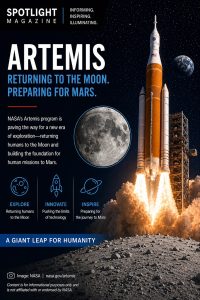
 The Artemis program is a major lunar exploration effort led by NASA, focused on returning humans to the Moon and building a lasting presence there. It builds on the legacy of the Apollo program, while looking ahead to future missions to Mars. A key part of Artemis is its strong international and commercial partnerships.
Key Facts
- Lead agency: NASA, working with partners like the European Space Agency (ESA), Japan Aerospace Exploration Agency (JAXA), and Canadian Space Agency (CSA)
- Primary goal: Sustainable human exploration of the Moon, especially the south pole
- Program start: Announced in 2017 as part of a long-term “Moon to Mars” plan
- First mission: Artemis I (uncrewed), November–December 2022
- Next major milestone: First lunar landing targeted no earlier than 2028
Goals and Approach
Artemis is built around three main ideas: scientific discovery, economic growth, and global collaboration.
The program aims to:
- Land the first woman and first person of color on the Moon
- Explore the lunar south pole, where water ice may exist in permanently shadowed craters
- Build the Lunar Gateway, a small space station orbiting the Moon
- Develop surface systems like habitats, rovers, and power infrastructure
- Test technologies needed for future missions to Mars, including long-term life support and resource use
To make this happen, Artemis brings together several major systems:
- The Space Launch System (SLS) rocket
- The Orion spacecraft for astronauts
- Commercial landing systems like Starship HLS and Blue Moon
- The Lunar Gateway and additional commercial cargo missions
Major Missions
- Artemis I (2022): An uncrewed test flight that sent Orion around the Moon and safely back to Earth, validating key systems
- Artemis II (planned 2026): First crewed mission, flying astronauts around the Moon on a free-return path
- Artemis III (target mid-2027): Planned return of astronauts to lunar orbit, with a landing dependent on readiness of systems
- Artemis IV (target ~2028): Expected to support a sustained presence at the Moon’s south pole and begin using the Gateway
Partnerships
Artemis is truly global. Through the Artemis Accords, more than two dozen countries have agreed to work together under shared principles for peaceful space exploration.
International agencies provide key hardware, while private companies—including SpaceX, Blue Origin, and Axiom Space—help deliver landers, spacesuits, and logistics. This approach is designed to support a growing “lunar economy.”
Challenges and Status
Like any large-scale space program, Artemis faces challenges. Technical hurdles, budget constraints, and development delays—especially with landing systems and next-generation spacesuits—have pushed timelines back.
Some reports suggest further delays are possible, but NASA continues to target a crewed landing around 2028 and is working to manage risk and keep the program moving forward.