
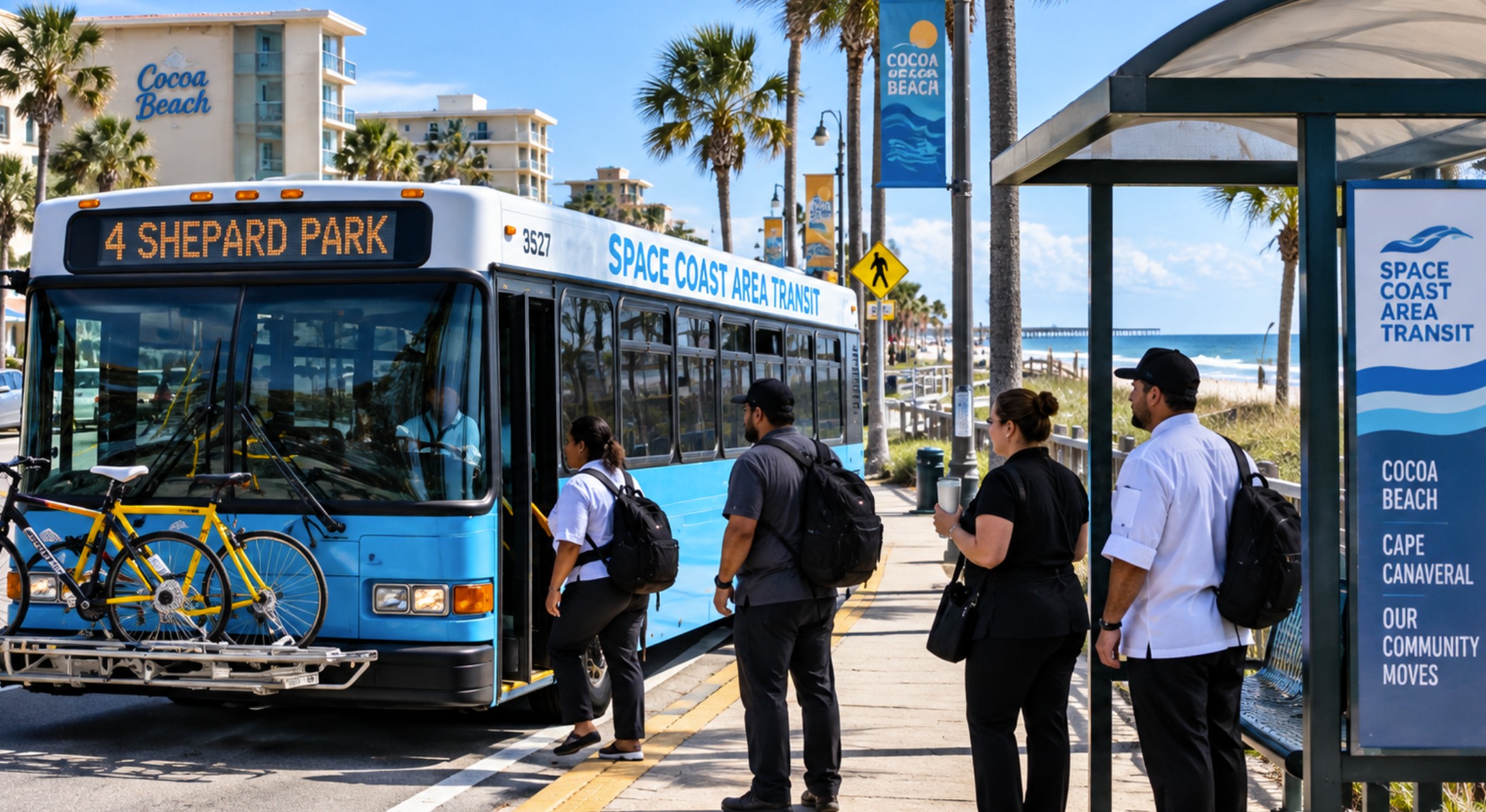
 BREVARD COUNTY, Fla. — Hundreds of hospitality workers who depend on public transportation to reach jobs in Cocoa Beach and Cape Canaveral could soon face a much more difficult commute following a state decision to end funding for a key transit program.
The Florida Department of Transportation is rescinding approximately $1.4 million in grant funding that has helped support bus service along Brevard County’s beachside corridor.
The decision has hotel managers, hospitality employees and local officials in Cape Canaveral and Cocoa Beach searching for solutions as they consider what reduced transit service could mean for the people who keep one of Brevard County’s most important tourism districts running.
For many of those workers, 321 Transit is not simply a convenient alternative to driving. It is how they get to work.
A Critical Route for Beachside Workers
Space Coast Area Transit, commonly known as 321 Transit, operates public bus service throughout Brevard County, connecting communities including Titusville, Cocoa, Rockledge, Merritt Island, Viera, Cape Canaveral, Cocoa Beach, Melbourne and Palm Bay.
The potential loss of beachside service is especially significant because of the number of hotels, restaurants, stores and tourism-related businesses operating in Cocoa Beach, Cape Canaveral and around Port Canaveral.
Many of those businesses depend on employees who live elsewhere in Brevard County and need reliable transportation to get across the county and onto the barrier island.
Transportation planning documents show that the state funding has played a direct role in keeping those connections operating.
During discussions with Cocoa, Cocoa Beach and Cape Canaveral, Space Coast Area Transit officials specifically reported that FDOT Corridor Grant funding was being provided to Routes 4 and 9. Local governments were also encouraged to explore opportunities for local funding.
That makes the loss of state funding much more than an accounting change.
It could directly affect how workers get to their jobs.
Route 9 Connects Cocoa Beach and Cape Canaveral
Route 9 provides service through Cape Canaveral and Cocoa Beach along the A1A corridor, helping connect riders with businesses, hotels and other destinations throughout the beachside communities.
The corridor has long been recognized as an important part of Brevard County’s public transportation network.
For hospitality employees working early mornings, nights, weekends and holidays, losing or reducing that service could create a major problem.
Unlike employees who have their own vehicles, transit-dependent workers cannot simply drive themselves to work when a route disappears or its schedule is reduced. Alternatives such as Uber and Lyft can also become expensive when used twice a day, five or more days a week.
The result could become a problem for employers as well as employees.
Hotels and restaurants already competing for workers could find themselves losing employees simply because those employees no longer have an affordable way to get to work.
Who Pays for the Service?
The loss of the $1.4 million grant also raises a larger question: If the state will no longer pay for the service, who will?
That discussion was already beginning before the latest funding issue.
According to transit planning documents, officials from Cocoa, Cocoa Beach and Cape Canaveral had expressed interest in exploring local funding opportunities. Before committing money, however, the cities wanted additional information from the transit agency, including daily and annual ridership numbers, operating costs and an explanation of how local dollars would be used.
Those conversations could now become considerably more urgent.
Possible solutions could require cooperation between Brevard County, Cocoa Beach, Cape Canaveral, tourism-related businesses and other community partners if they hope to maintain transportation for the workers who rely on it.
Transportation and Brevard’s Economy
The issue also demonstrates how closely transportation and economic development are connected.
Brevard County’s beachside tourism industry depends on more than visitors. It depends on the housekeepers cleaning hotel rooms, cooks and servers working in restaurants, maintenance employees keeping properties operating and hundreds of other workers who report to work every day.
Public transportation helps connect those employees with their jobs.
The Space Coast Transportation Planning Organization’s current transportation program includes road, transit, bicycle, pedestrian, technology, rail, aviation and safety projects throughout Brevard County, illustrating the many different transportation needs competing for available state, federal and local dollars.
At the same time, Brevard County continues making major investments in its transportation future. In August, the region celebrated approximately $57.5 million in federal funding for the Cocoa Multimodal Station and Rail Project, which is intended to eventually bring passenger rail service directly to the Space Coast.
Those long-term projects could transform transportation in Brevard.
But for workers who need to get to a hotel or restaurant in Cocoa Beach tomorrow morning, the immediate concern is much simpler:
Will there still be a bus to get them there?
The loss of approximately $1.4 million in state transit funding now leaves local governments, businesses and transportation officials with difficult decisions about how — and whether — that service can be maintained.
For hundreds of workers who depend on public transportation to earn a paycheck, those decisions could have a very real impact on their ability to continue working beachside.