
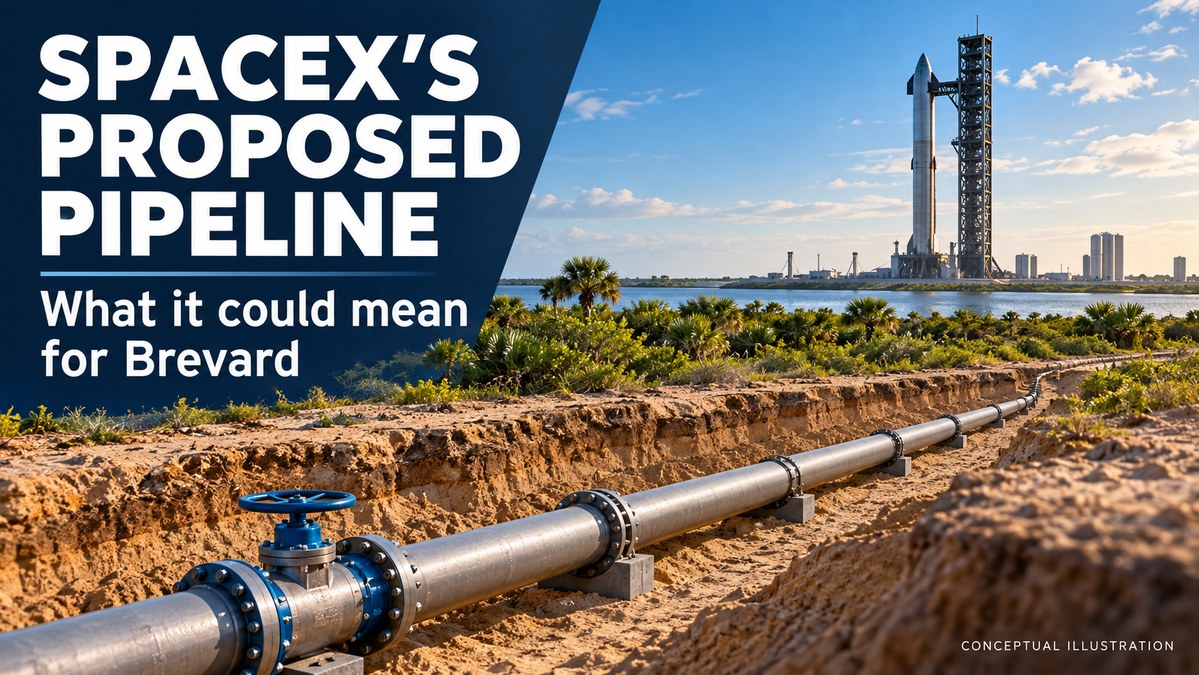
 Rocket launches may capture the headlines, but the infrastructure supporting them can have an impact much closer to home.
A SpaceX subsidiary, Coastal Connect Services, is proposing a 32.4-mile natural gas pipeline entirely within Brevard County. The planned 16-inch steel line would connect to the Florida Gas Transmission system and supply SpaceX’s Cape Canaveral operations, according to Florida Public Service Commission documents.
The proposal raises practical questions for Space Coast residents: Where would the pipeline go? Could construction affect roads or nearby properties? What environmental safeguards would apply?
Why SpaceX Wants a Pipeline
SpaceX says its growing operations require a more dependable supply of natural gas, which it liquefies for rocket fuel. In responses summarized by state regulators, Coastal Connect Services said deliveries currently arrive by truck and that hundreds of truckloads of liquefied natural gas can be required per launch.
The project is connected to preparations for future Starship operations. According to News 6, the company argues that trucking alone would struggle to meet the volume and reliability needed as launch activity increases. A pipeline could reduce its reliance on those deliveries.
That gives the proposal a transportation angle as well as a space industry angle. One question worth examining is how many truck trips the pipeline could replace and which local roads would see a difference.
What Has the State Approved?
On October 6, 2026, the Florida Public Service Commission voted to approve Coastal Connect Services’ natural gas transmission tariff. A tariff establishes the rules and terms under which a company provides service. The commission also accepted staff recommendations addressing the transportation agreement and procedures for potential challenges.
Residents should distinguish that decision from approval of every part of the physical project. News 6 reported that the commission’s action concerns gas transportation service and rates, rather than environmental authorization for construction of the entire pipeline.
The October 6 vote alone therefore should not be read as confirmation that all permits are complete or construction is ready to begin.
The Route Will Matter to Residents
The documents reviewed for this article establish the pipeline’s proposed length and its connection to the existing gas transmission system. They do not provide enough detail to identify every neighborhood, road crossing or property that could be affected.
Those details will be essential to understanding the local impact. Questions for future project filings and public discussion include:
- Would construction follow existing utility corridors or require new easements?
- Which roads could experience temporary closures or work zones?
- Would the route cross wetlands, waterways or sensitive habitat?
- How would disturbed land be restored?
- How would nearby residents receive construction updates?
These are questions to investigate, rather than confirmed impacts of the proposed route.
Environmental and Safety Questions
News 6 reported that environmental advocates have raised concerns about the cumulative effects of expanding launch operations and supporting infrastructure near sensitive Space Coast habitat. SpaceX, meanwhile, presents the pipeline as a way to provide reliable fuel deliveries while reducing dependence on tanker trucks.
Evaluating those competing considerations will require project-specific information. Residents should look for details about construction methods, habitat protection, leak detection, emergency response and responsibility for long-term maintenance.
A useful public discussion would examine both the effects of building and operating the pipeline and the truck deliveries it is intended to replace.
What Brevard Should Watch Next
The most useful next developments will be a detailed route, information about applicable permits, a construction schedule and clear opportunities for public input.
Residents following the state proceedings can reference Florida Public Service Commission Docket No. 20260094-GU, which covers Coastal Connect Services’ tariff and transportation service agreement.
For Brevard County, the proposal shows how growth in commercial space operations reaches beyond the launchpad. Understanding what this pipeline could mean locally will depend on the details of where it is built, how it is reviewed and how the people along its route are informed.